After backlash, CDC revises plan to retire research monkeys to Texas sanctuary—Science (June 22, 2026)
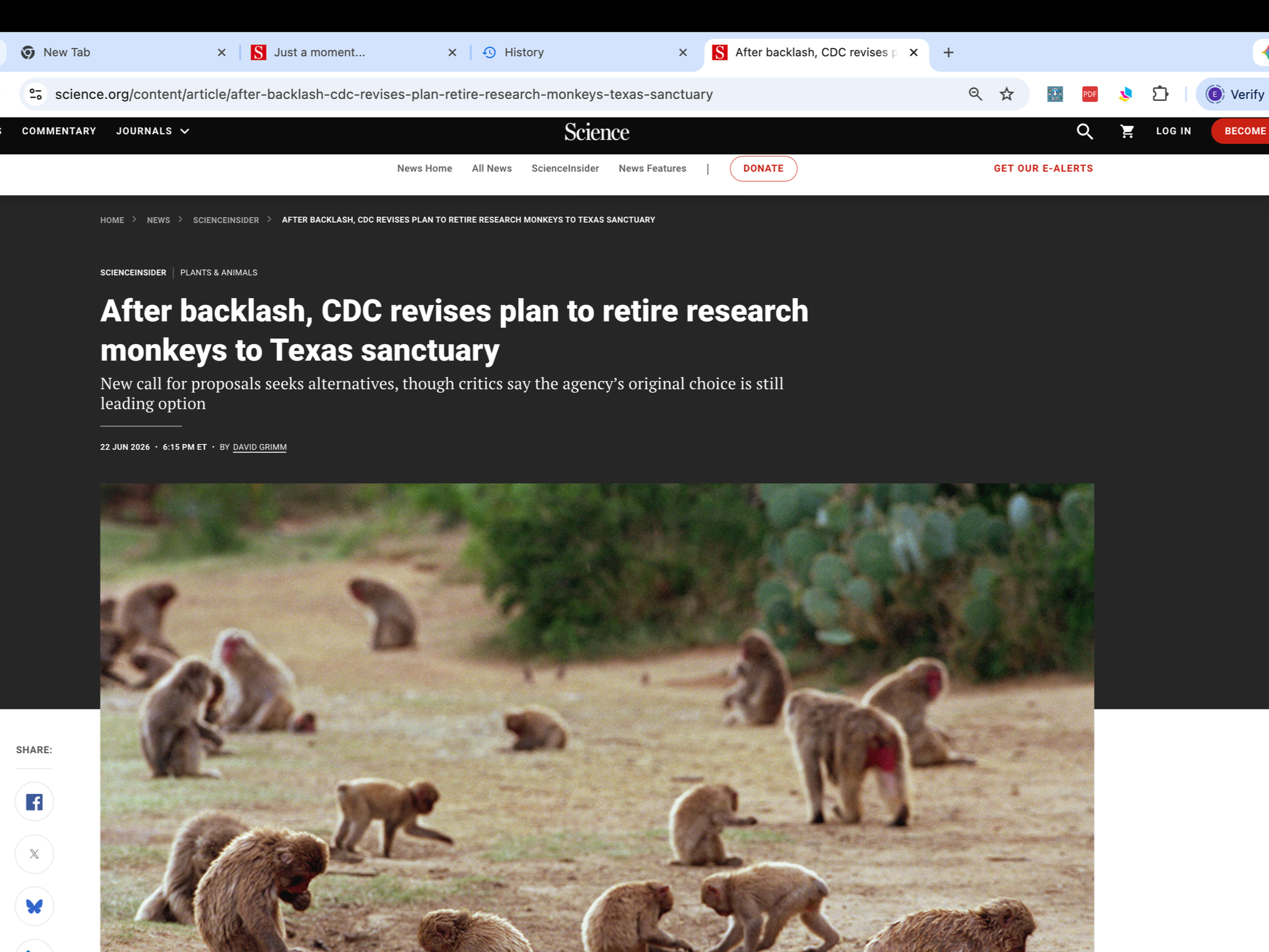
The U.S. Centers for Disease Control and Prevention (CDC) has seemingly backtracked on a plan to send its research monkeys to a Texas sanctuary. In May, the agency announced it would retire up to 162 rhesus and pigtail macaques to Born Free USA, a 70-hectare refuge near the Mexican border. But after an uproar from critics in the biomedical community, who claimed the plan was rushed and could endanger the animals, the agency posted a new “contract opportunity” over the weekend that opens the door for more facilities to apply….
Eric Kleiman, senior policy adviser for the American Anti-Vivisection Society, hopes CDC’s monkeys still end up at Born Free. The sanctuary, which the society has provided financial support to for years, has a long track record of exemplary animal care, he says, an assertion Taylor echoes. “We continue to feel that the decision was justified,” Kleiman says.
Leading supplier of research monkeys declares bankruptcy—Science (June 8, 2026)
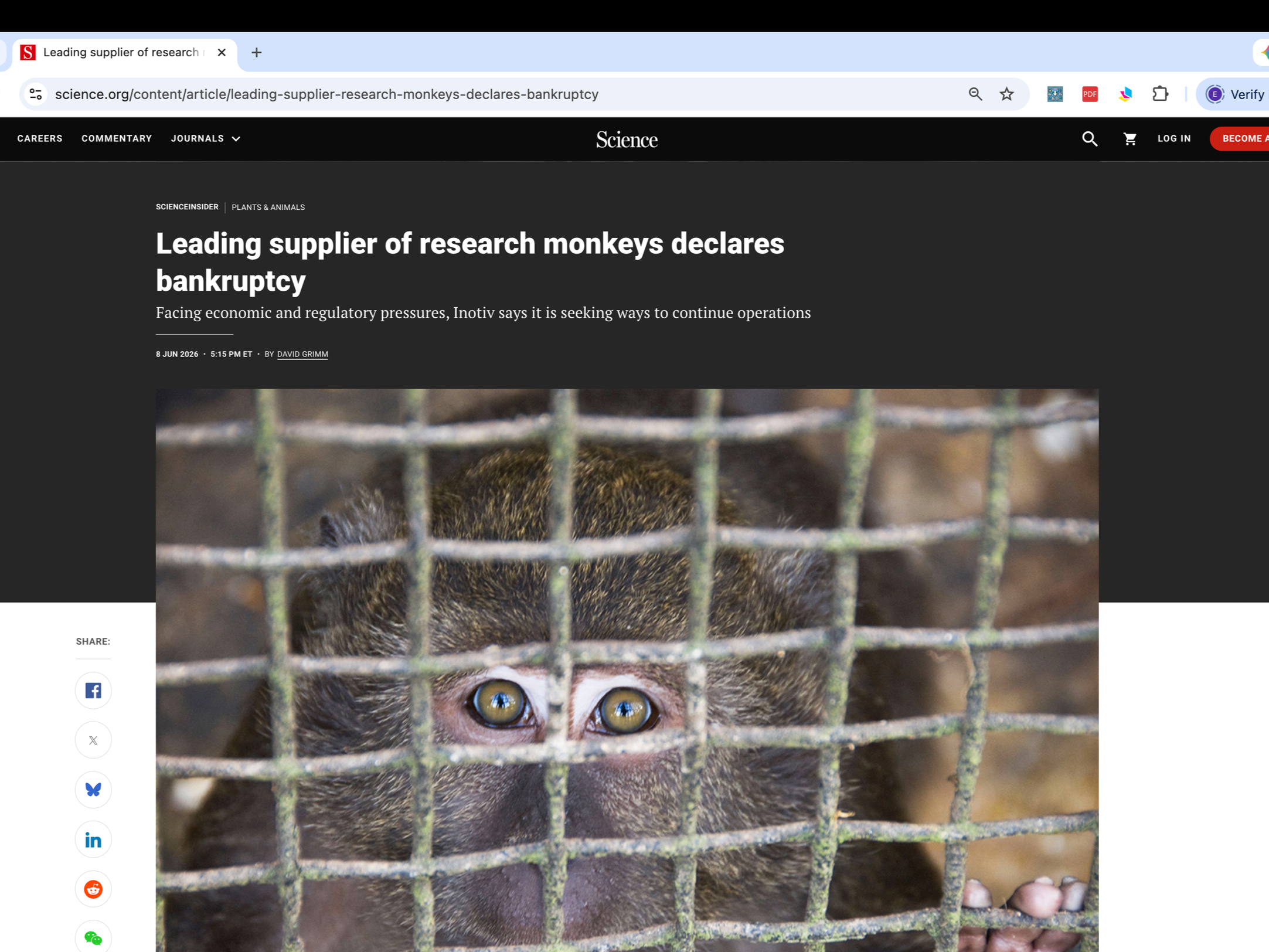
One of the world’s leading suppliers of monkeys and other animals for biomedical research has declared bankruptcy. In court filings last week, Inotiv, a West Lafayette, Indiana–based company, said it is nearly a half-billion dollars in debt and is seeking ways to continue operations as it financially restructures….
Inotiv did not respond to a request for comment, but in a press release on the bankruptcy filings, the company said it has arranged to borrow $25 million for its overhaul. “The Company will maintain normal operations without disruption and continue to deliver critical research models and services to its clients,” it said.
Eric Kleiman hopes that doesn’t happen. As a senior policy adviser for the American Anti-Vivisection Society, which opposes the use of laboratory animals, he has closely followed the situation at Envigo and at Inotiv’s other operations. Kleiman says Inotiv should have shut down years ago. “Perhaps now its doors will finally shutter, just like the beagle breeding site it was forced to close,” he says. “Bankruptcy couldn’t happen to a more deserving company.”
Death of research hummingbird at UC Riverside triggers third animal welfare citation in 3 years—Orange County Register, San Jose Mercury News, and Press-Enterprise (May 26, 2026)
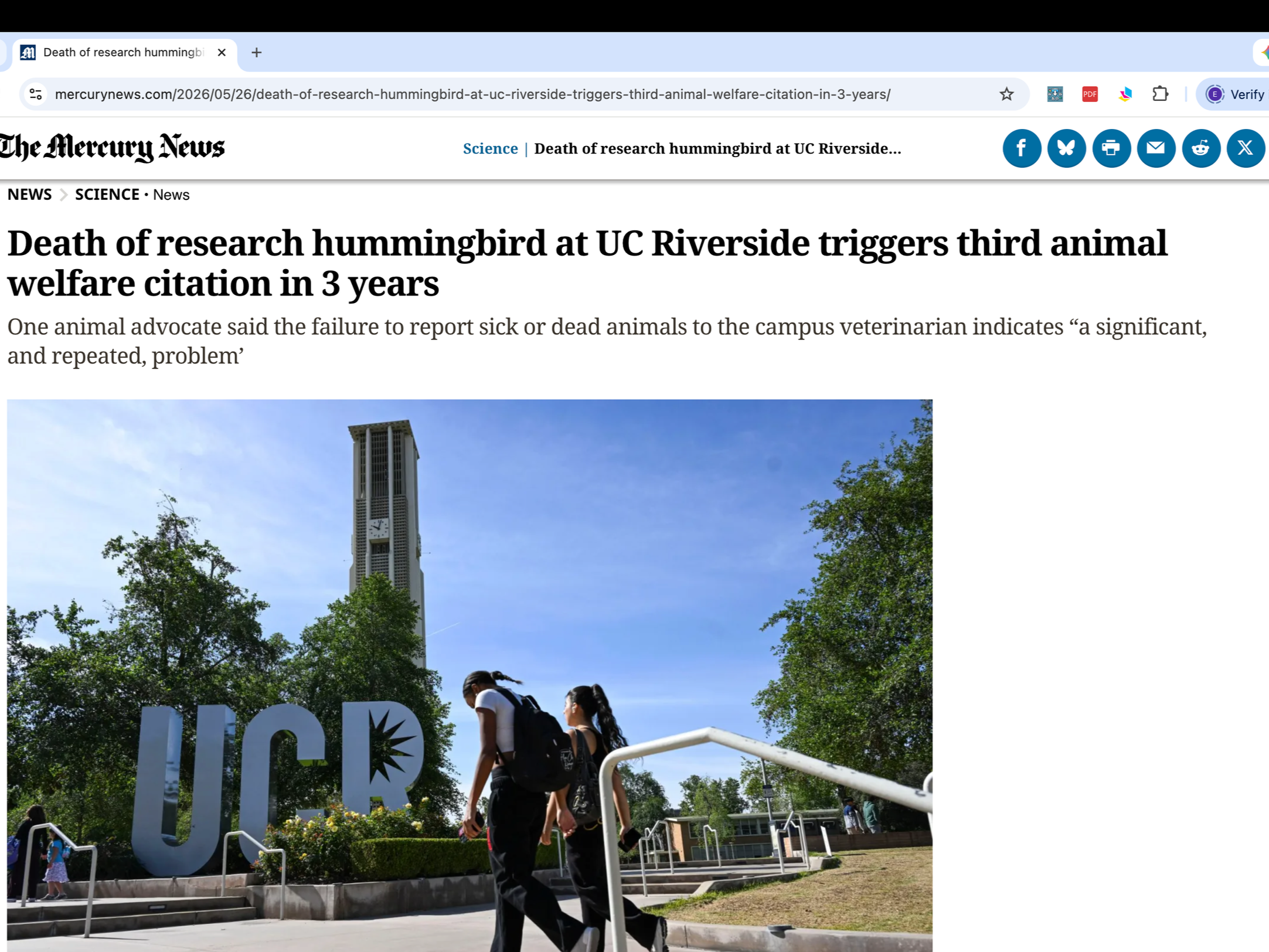
The death of a hummingbird used in research has landed UC Riverside in hot water with the federal government for a third time in three years over evidence of animal welfare abuses….
During this same time frame, fewer than a dozen other research facilities around the country have received the same number of critical citations for incidents involving animal deaths, according to Eric Kleiman, a senior policy adviser to the American Anti-Vivisection Society.
In the past, UC Riverside may have received a fine for these infractions, Kleiman said, but thus far, the university has only received warning letters, likely because of a 2024 Supreme Court decision that limited the ability of government agencies to issue fines. Kleiman submitted complaints to the National Science Foundation, which has provided funding for UC Riverside animal research, and the NIH’s Office of Laboratory Animal Welfare over the university’s lab animal deaths….
These emails show that, at the time, the university’s attending veterinarian was concerned by the lack of reporting.
“Voles are a USDA covered species,” wrote the veterinarian, whose name is redacted. “Now that I have lost the opportunity to investigate the cause of deaths, I am concerned that our institution may be in violation of the Animal Welfare Act.”
The principal investigator for the vole research informed the attending veterinarian that she was “unaware” of the requirement to report dead animals, according to those records.
Kleiman says he was “shocked” to see that admission.
“My jaw dropped,” he said. “I don’t remember ever seeing anything like that, in over 30 years” of animal advocacy.
These failures to report sick or dead animals to the campus veterinarian indicate “a significant, and repeated, problem at UC Riverside, which I believe goes to the heart of providing adequate veterinary care to animals at this institution,” Kleiman said.
Hummingbird death triggers UC-Riverside’s third federal animal-welfare citation in 3 years—Yahoo! News and MSN (May 27, 2026)
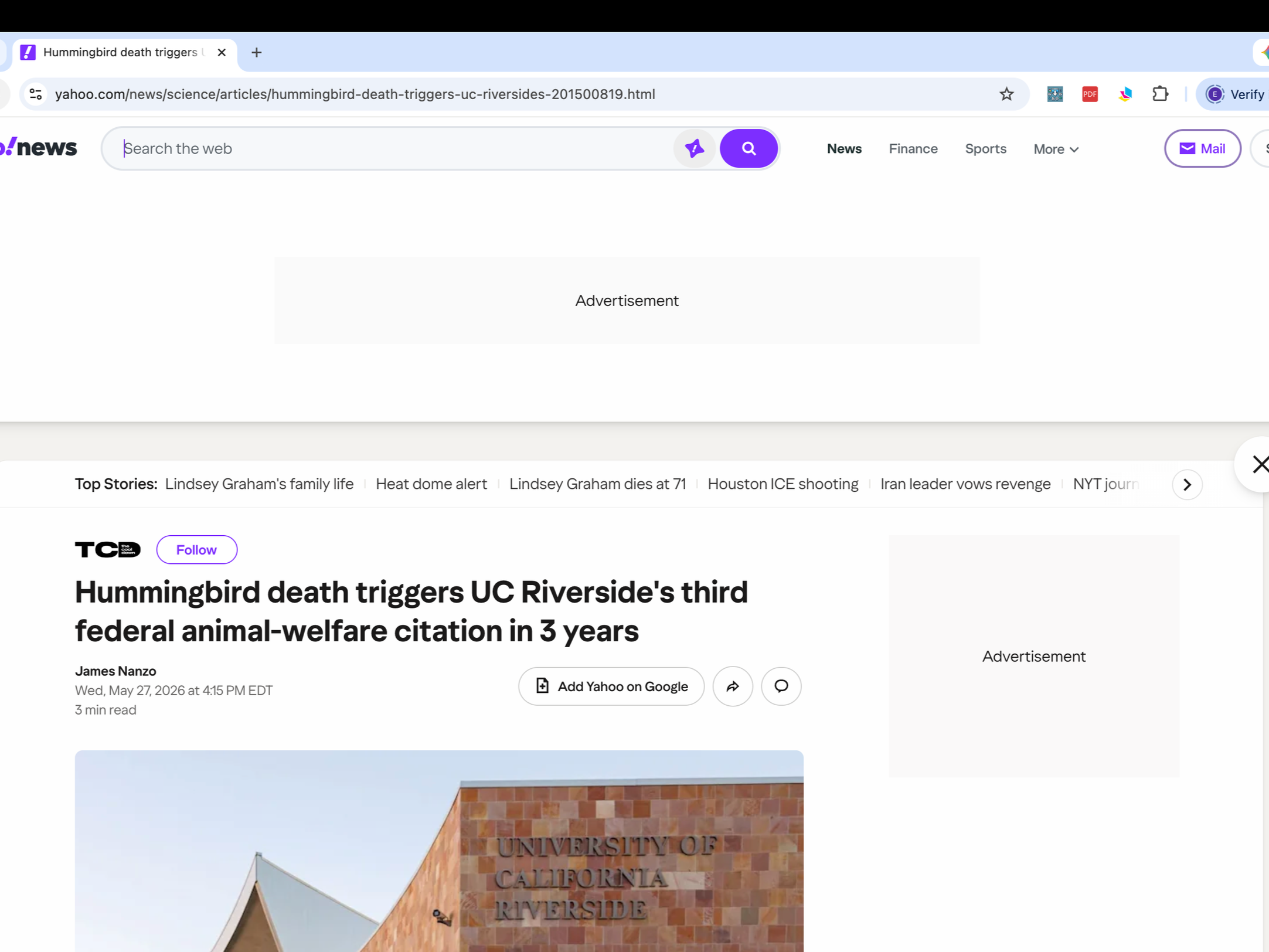
A hummingbird's death just two days after being taken from the wild is bringing renewed scrutiny to the University of California, Riverside, as The Press-Enterprise reports….
Eric Kleiman, a senior policy adviser to the American Anti-Vivisection Society, told The Press-Enterprise that a small number of other research facilities nationwide have received as many critical citations over the same time period.
He added to the outlet that the events point to "a significant, and repeated, problem at UC Riverside.”…
In the latest case, the repeated failures involved delayed reporting of serious illness or death, which inspectors said limited opportunities for veterinary intervention….
Outside groups are also pressing for stronger oversight. Kleiman said he filed complaints with the National Science Foundation and the National Institutes of Health's Office of Laboratory Animal Welfare.
MAHA Is Monkeying Around With Lab Rats—The New Republic (May 4, 2026)
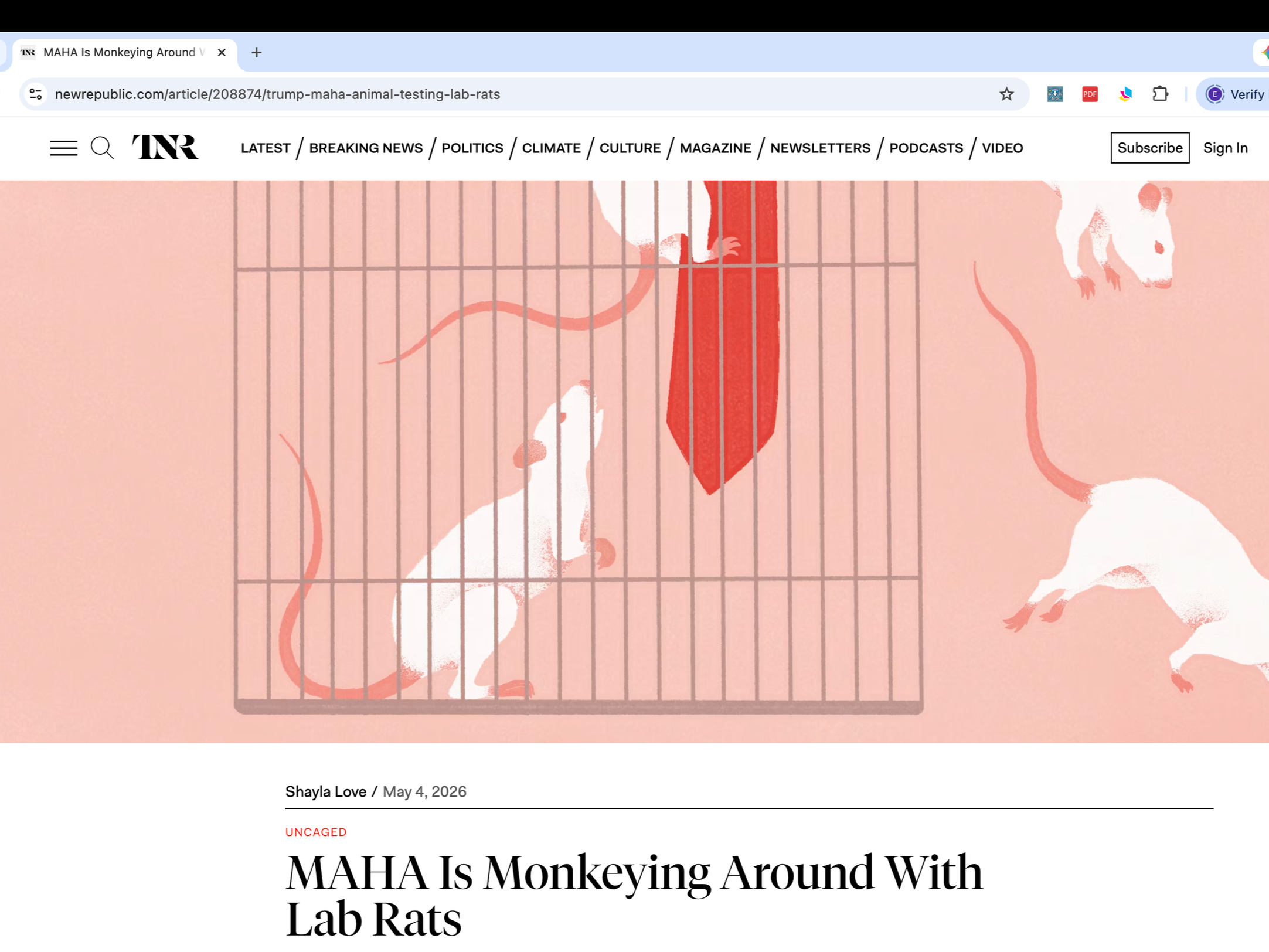
What exactly is going on with the right’s focus on animal welfare? The exact number of animals involved per year in the United States for testing isn’t well accounted for, but it is certainly in the millions. Although the majority are rodents, others, including rabbits, guinea pigs, dogs, cats, and nonhuman primates, are used, too. There are plenty of reasons to want to reduce this number. Not only can experimentation lead to the suffering and death of the animals involved, but the findings from nonhuman animals don’t always translate to humans—especially when it comes to drug development. Many medications fail when they move from animal models to humans, and scientific advancements have dramatically improved the available alternatives to animal testing. The government’s latest moves have “opened up possibilities that I, for one, never imagined,” said a senior policy adviser at the American Anti-Vivisection Society, Eric Kleiman.